
Optical Properties of Nanostructures
|
|---|

The fabrication of nanostructures requires a deeper understanding of the physical phenomena involved at this scale. Low-dimensional quantum structures have shown to have unique optical and electronic properties, which have been employed in the fabrication of new opto-electronic devices. In particular, the shape and size of low-dimensional structures are crucial parameters to determine their physical properties. It is well known that the distribution of electronic states on a nanostructure depends on its size, and the confinement potential acting on the electrons is associated to its shape. Therefore, the exact knowledge of the size and shape of a nanostructure is of decisive importance in the development of the science and technology at the nanometer scale. Furthermore, the characterization of these parameters are important issues either in fundamental research or in technological applications, covering from growth and characterization to device processing. The chiral nature of the clusters, which means they exist in distinct right-handed and left-handed variations, dramatically affects the way in which they absorb polarized light. This optical effect had been predicted theoretically to occur in metal nanostructures, and it has been observed experimentally in a special class of clusters.
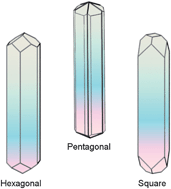
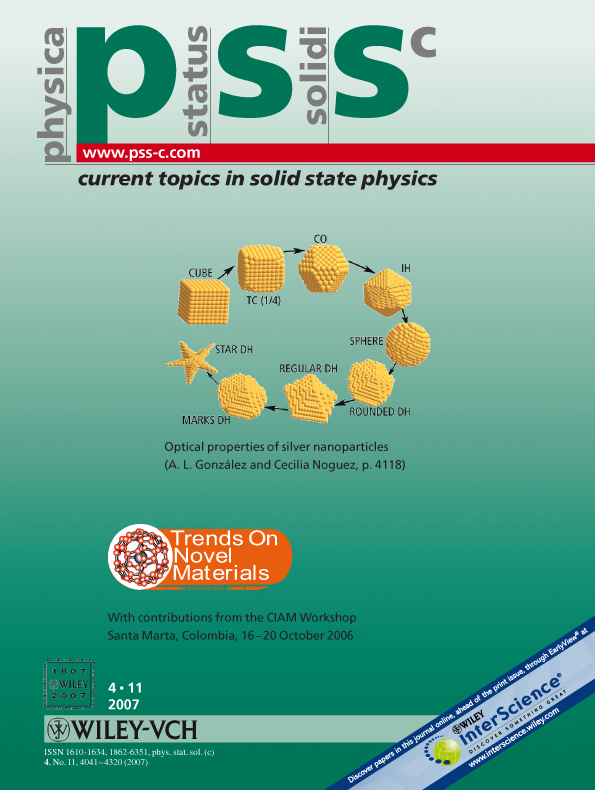
Mapping the Structural and Optical Properties of Anisotropic Gold NanoparticlesThe morphology and optical properties of gold nanorods are obtained using a strategic combination of theoretical and numerical techniques. Shape-dependent phase diagrams are developed, and the structural and color properties of anisotropic gold nanoparticles are predicted for two different sizes and colloidal concentrations. Calculated maps reveal an intimate relationship between size, morphology, temperature, environment, and optical properties, and confirm that the aspect ratio of the nanorod is an important factor influencing the color of the colloidal samples. When the aspect ratio value is between 1 and 5, the color of the sample changes from pink to blue and green, but if the aspect ratio is larger than 5 the colloid shows slight color variations in green-yellow hues. It is also found that although the solution is heated, at temperatures below melting point, there can be a transition in morphology but the color remains the same for a given aspect ratio, so morphological variations are unlikely to degrade the optical performance, provided the aspect ratio is preserved. We also conclude that the nanorod size plays a secondary role, in contrast to common assumption, since the color palette is quite independent of size. Color variations of samples with different refraction indices and the effect of different ‘end truncations’ for square nanorods are also examined in detail, both of which can modify the relationship between aspect ratio and color transition, although the overall color palette remains the same. As we will show, the theoretical results discussed here are in excellent agreement with experimental observations. More ... . |
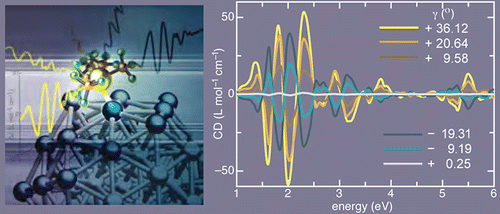
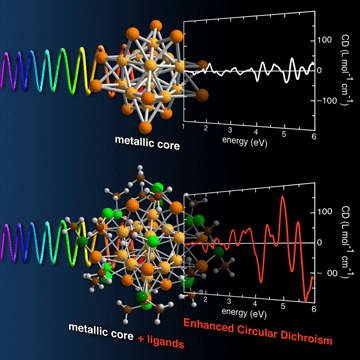
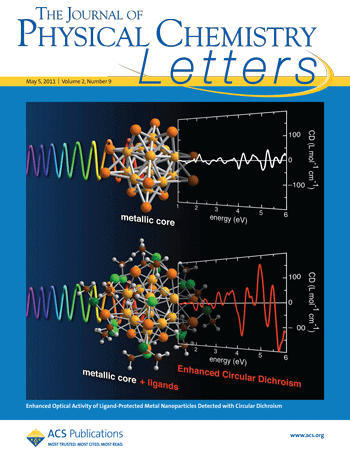
Optical Activity of Achiral Ligand SCH3 Adsorbed on Achiral Ag55 Clusters: Relationship between Adsorption Site and Circular DichroismIn recent years, many research has been dedicated to understand and predict the interaction of light with nanostructures, which exhibit a wide variety of interesting physical properties that can be tailored by altering their size, morphology, composition, and environment. One emerging area in nanoscience is the phenomenon where the optical activity can be influenced and enhanced due to the presence of metal nanoparticles, with possible technological implications in sensing and labeling chiral molecules, asymmetric catalysis, pharmacology, toxicology, among other applications. In this Perspective article, we talk about the theoretical aspects of this phenomenon and the relationship between morphology and the optical activity enhancement in ligand-protected metal nanoparticles. More ...
|
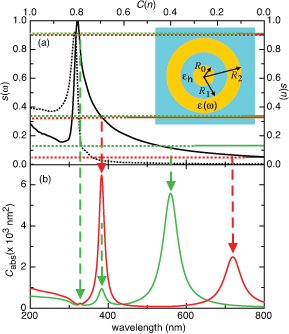
Designing the plasmonic response of shell nanoparticles: spectral representationA spectral representation formalism in the quasi-static limit is developed to study the optical response of nanoparticles, such as nanospheres, nanospheroids, and concentric nanoshells. A transfer matrix theory is formulated for systems with an arbitrary number of shells. The spectral representation formalism allows us to analyze the optical response in terms of the interacting surface plasmons excited at the interfaces by separating the contributions of the geometry from those of the dielectric properties of each shell and surroundings. Neither numerical, nor analytical methods can do this separation. These insights into the physical origin of the optical response of multi-shelled nanoparticles are very useful for engineering systems with desired properties for applications in different fields ranging from materials science and electronics to medicine and biochemistry. More ...
|
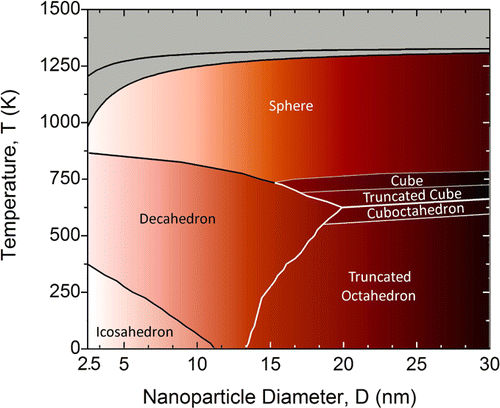
Map of the Structural and Optical Properties of Gold Nanoparticles at Thermal EquilibriumThe remarkable relationship among the size, shape, and optical properties of gold nanoparticles is proving to be very useful in a range of high-performance applications. Considerable effort and investment is focused on delivering gold nanoparticles with precise morphologies. However, the reliability of these particles is contingent upon the morphological stability, particularly against variations in the thermodynamic environment, such as changes in temperature. Presented here are results from a combination of computational and theoretical techniques showing how the optical properties of gold nanoparticles respond to changes in the size, shape, or temperature, obtained by sampling the optical spectrum over large configuration space, in accordance with the nanoscale phase diagram. We find that spectrum from morphologies expected at small sizes is robust against temperature fluctuations, unless the concentration is very high. At larger sizes, the color will likely change with temperature, due to the accompanying change in particle shape, and this change will be noticeable when the concentration is low. More ...
|
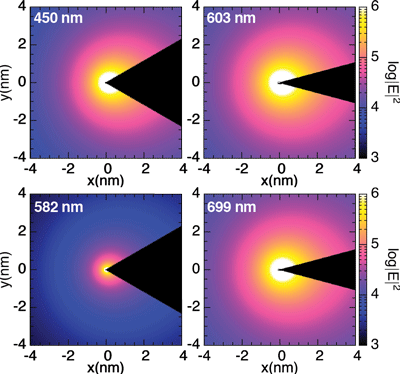
Electromagnetic Field Enhancement at the Edge of Metal NanostructuresThe role of localized surface plasmon resonances near the surface of a silver or gold wedge is discussed based on quasistatic theory. Strongly enhanced electromagnetic field intensities at moderate distances of 1~nm from the wedge are found by manipulating morphology and dielectric environment. The theory also shows that wedge structures can have high enhancements over a broad range of wavelengths, which is of relevance to surface-enhanced Raman scattering and Tip Enhanced Raman Scattering measurements and for improving plasmon enhanced photovoltaic devices. More ...
|
The Role of Morphology in the Enhanced Optical Activity of Ligand-Protected Metal NanoparticlesIn recent years, many research has been dedicated to understand and predict the interaction of light with nanostructures, which exhibit a wide variety of interesting physical properties that can be tailored by altering their size, morphology, composition, and environment. One emerging area in nanoscience is the phenomenon where the optical activity can be influenced and enhanced due to the presence of metal nanoparticles, with possible technological implications in sensing and labeling chiral molecules, asymmetric catalysis, pharmacology, toxicology, among other applications. In this Perspective article, we talk about the theoretical aspects of this phenomenon and the relationship between morphology and the optical activity enhancement in ligand-protected metal nanoparticles. More ...
|